If you've ever stood on a balcony with a frameless glass railing and felt like you were floating, you already understand the appeal. But "frameless" is a category, not a product — and the system you specify determines how the railing looks, how much it costs, and how it handles wind and impact.
Base-shoe systems: the modern default
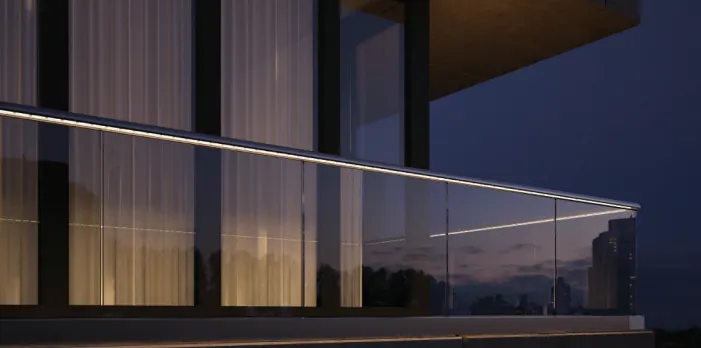
A base-shoe railing clamps the bottom edge of the glass into a continuous aluminium U-profile bolted to the slab. The result is a clean, continuous line at the floor with no visible posts. ALUVISTA AV-R50NEO, AV-C50LED and AV-N50 are all base-shoe systems sized for different glass thicknesses and applications.
Base-shoe is the right answer when you want maximum transparency, a flush floor edge, and the freedom to choose any top-rail finish — or none at all.
Top-rail vs no top-rail
A top-rail (typically a slim aluminium cap) is required by some local codes and adds a useful handhold on staircases. Aesthetically, it gives the railing a finished, framed look from a distance.
Going without a top-rail is permitted on terraces and balconies in most jurisdictions when the glass is correctly specified (typically 17.5 mm laminated for balcony fall protection). Always confirm with your engineer before locking in the spec.
Standoff (point-fixed) systems
Standoff systems fix glass with discrete polished metal point-fixings — usually on the face of a slab or on architectural fins. They give the lightest possible visual footprint and read as pure glass from a distance. They cost more, demand more precise structural backing, and have a smaller load envelope than base-shoe.
Use standoff where the architectural intent is hero-level glass and the slab edge can take a face fixing. Use base-shoe for everywhere else.
What thickness of glass?
Glass thickness is set by span, load, height and whether the railing forms fall protection. For typical balcony applications across Bulgaria we specify 16.76 mm or 17.52 mm laminated tempered glass on base-shoe systems — strong enough to retain integrity even after impact, with the laminate layer holding the panel in place.
Pool and stair railings can sometimes use 12 mm, but always engineer to the actual installation and local code rather than copying a previous project.
Installation lead time
Base-shoe systems with leveling adjustment (AV-R50NEO, AV-N50) install fastest because each panel can be fine-tuned ±2° on site, so the underlying slab does not need to be perfect. Plan 1–2 days for a typical balcony, plus 2–4 weeks lead time for tempered laminated glass to be cut and processed.