Above 20 m the rules change. Wind pressure at facade corners on a 40 m tower can reach 1.85 kN/m² — well above the 0.5 kN/m line load that a residential balcony railing has to resist. At that point the interlayer in your laminated glass, and the presence or absence of a structural top-rail, stop being aesthetic choices and become structural ones. This guide walks through two railing strategies used on tall residential and mixed-use buildings.
What the codes ask for above 20 m
Bulgarian Ordinance RD-02-20-3 / №7 (MRRB) sets a minimum railing height of 1.20 m above finished floor for buildings taller than 20 m. EN 1991-1-1 sets the horizontal line load — 0.5 kN/m for residential (Category A) and 1.5 kN/m for public-access ground floors (Category C3). EN 1991-1-4 governs wind, and on a 40 m residential tower in terrain category III, peak velocity pressure is roughly 0.97 kN/m², giving net pressures around 1.30 kN/m² on typical facade zones and up to 1.85 kN/m² at corners.
For Category A balconies the wind load — not the line load — drives the design. That means the railing system has to handle a higher bending moment than a typical low-rise project, and the post-fracture behaviour has to satisfy DIN 18008-4 (glazing with a fall-protection function).
Option 1 — true frameless with ionoplast interlayer
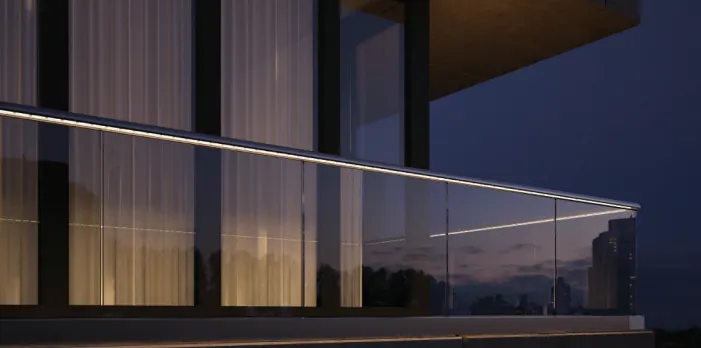
When the architectural intent is uninterrupted glass — no top-rail, no visible cap — the laminated panel does all the work. For high-rise buildings the glass must be at least two layers of 10 mm each, with the final thickness determined by structural calculation; depending on wind load and span, this can grow to 25 mm, 30 mm, or even 35 mm total. The interlayer is an ionoplast (SGP-type) film, typically 1.52 mm, set into a continuous aluminium base-shoe with mechanical wedge clamping.
Ionoplast is the right interlayer here for three reasons: it is roughly 100× stiffer than PVB at room temperature, it retains shear capacity at the summer slab temperatures (+50 °C) that pure PVB loses, and after a panel breaks the ionoplast layer holds the shards in a self-supporting cantilever long enough to safely replace the unit. The glass must be Heat-Soak Tested (EN 14179) so spontaneous NiS breakage on the facade is statistically eliminated.
- Glass: minimum 2×10 mm with ionoplast interlayer, final thickness by calculation (up to 25–35 mm), HST tempered, polished edges, EN 12600 class 1B1.
- Fixing: continuous aluminium base-shoe, EN AW-6063 T5, stainless A4 anchors.
- Visual: no top-rail; open polished glass edge along the entire run.
- Post-fracture: ionoplast interlayer self-supports a broken panel until replacement (DIN 18008-4).
Option 2 — economical EVA with structural top-rail
When budget or lead time matters more than a pure frameless line, heat-strengthened (TVG) laminated glass with an EVA interlayer combined with a structural aluminium top-rail is the rational alternative. A typical build-up is 10 mm TVG + 2 mm EVA + 10 mm TVG (22 mm nominal) in a continuous aluminium base-shoe, with a continuous load-bearing handrail anchored back to the structure.
The structural top-rail does two jobs at once. First, it restrains the top edge of every panel, turning each pane from a free cantilever into a propped cantilever — deflection drops dramatically, so a thinner / cheaper laminate satisfies the BS 6180:2011 limit (the lesser of L/65 or 25 mm). Second, in the broken-glass state it carries the line load between anchor points, providing the residual fall protection that the pure-frameless system gets from the ionoplast interlayer alone.
TVG is used instead of fully tempered because it does not need Heat-Soak Testing (HST is recommended only for ESG / fully tempered). EVA is widely available from local laminators, which compresses lead time and simplifies logistics.
- Glass: 10/2 EVA/10 (22 mm) heat-strengthened TVG, polished edges.
- Top-rail: structural aluminium profile, continuous, anchored to slab / structure.
- Visual: classic capped balustrade line; vertical joints only at corners (6–8 mm structural silicone).
- Best for: cost-sensitive towers, faster delivery, projects where a handrail is welcome.
Standards both systems comply with
EN 1990 (basis of design), EN 1991-1-1 (line loads on barriers), EN 1991-1-4 (wind), EN 16612 / 16613 (glass load resistance and interlayer behaviour), EN 12600 (impact classification — class 1B1), BS 6180:2011 (barrier deflection limits, handrail requirements) and DIN 18008-4 (post-fracture verification for fall-protection glazing).
On handover ALUVISTA provides Declarations of Performance (DoP) under CPR (EU) 305/2011, certificates of origin and quality, warranty documentation and acceptance protocols.
Which one is right for your tower?
Choose the ionoplast frameless route when uninterrupted glass is the defining architectural move, when the developer values long-term residual strength on the facade above first-cost optimisation, and when lead time tolerates imported ionoplast-grade laminated glass.
Choose the EVA + structural top-rail route when the brief is to deliver a compliant, modern glass balustrade at the most efficient budget and on a tighter schedule, with the handrail line read as a feature rather than a compromise. Both are fully code-compliant; the choice is about architecture and economics, not about safety.