A balcony railing is fall protection first and a design element second — but a well-specified railing does both effortlessly. This guide covers the standards that drive the height, load and glass thickness of your railing, and the design choices left to you once those are settled.
Height requirements (Bulgarian regulations)
In Bulgaria railing heights are strictly regulated mainly by Ordinance No. 7 on the rules and regulations for territory planning (Art. 90) and Ordinance No. RD-02-20-2 on accessible environment.
For standard residential buildings the minimum height is 1.05 m above finished floor level.
For high-rise buildings (floors above 20 m height) the minimum height is 1.20 m.
ALUVISTA railings ship standard at 1.10 m for residential and 1.20 m for public-access applications. We engineer custom heights for hospitality and architectural projects.
Load requirements (EN 1991-1-1)
European code EN 1991-1-1 sets the horizontal line load at the top of the railing. For residential balconies that's 0.5–1.0 kN/m; for public spaces with crowds it's up to 3.0 kN/m. Every ALUVISTA system is tested against these loads with appropriate post spacing for the specified glass.
If you're combining glass with an aluminium top-rail, the top-rail carries the line load and the glass acts as in-fill — this is usually the cheapest compliant solution.
Child safety: no-climb geometry and gap limits
Wherever children may be present (housing, schools, kindergartens, hotels, public buildings), the railing must be designed so that it cannot be climbed and cannot be passed through. This is required by Ordinance No. 7 and Ordinance No. RD-02-20-2 on the design of buildings, and it is independent of the height and line-load requirements.
No-climb rule: horizontal members, ledges, mid-rails or any repeating profile that can act as a foothold are not permitted in the in-fill zone between the floor and the top of the railing. Pickets and any structural elements in this zone must be vertical. A continuous top-rail and a continuous base profile are allowed because they cannot be used as a step; everything in between must remain unclimbable.
Gap rule: no opening in the railing — between pickets, between a picket and a post, or between the railing and the floor — may allow a sphere of 125 mm diameter to pass through (maximum clear gap approximately 90 mm). The same limit applies to the gap under the bottom rail.
French windows: for both non-opening and opening external French windows, installation of a protective railing on the interior side at the same regulatory height is mandatory.
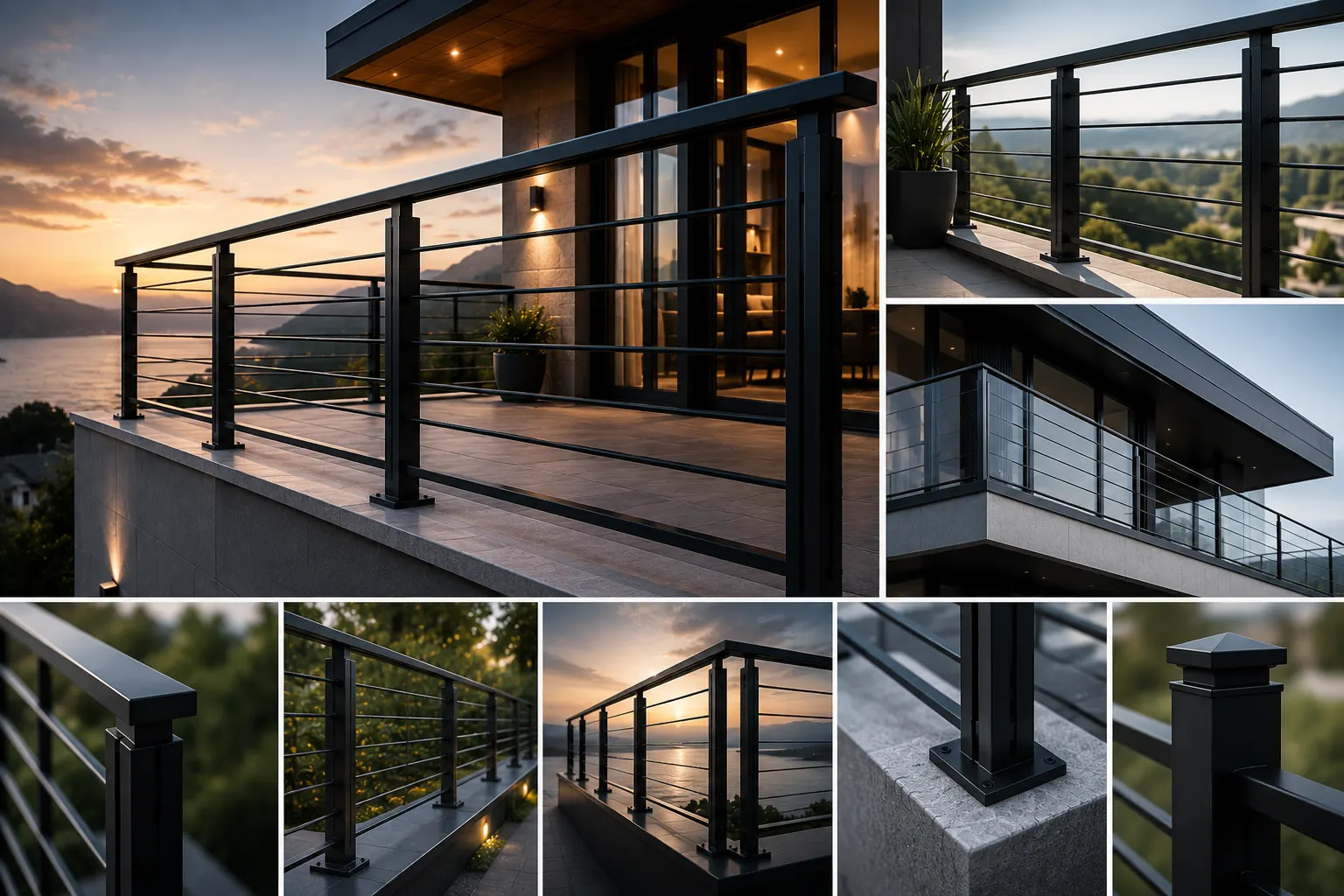
Practical consequences for design: vertical-picket systems are specified at ≤ 90 mm clear centre-to-centre opening; framed glass and frameless glass panels naturally satisfy the no-climb and gap rules as long as the panel-to-post and panel-to-floor gaps stay within 90 mm; cable, rod and any horizontal-bar railings are not used on child-accessible balconies.
Design choices that remain
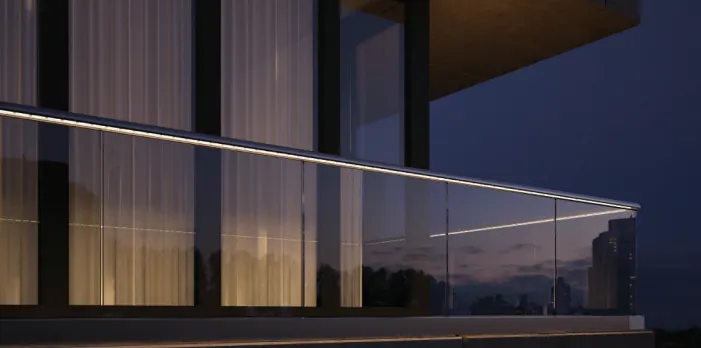
Once safety is settled, you choose: framed or frameless, glass tint, top-rail or no top-rail, anodised or powder-coated aluminium, RAL colour. Frameless glass with no top-rail reads as the cleanest, most modern option; framed vertical aluminium picket railings (AV-SL22) read as more classical and architectural.
Whatever you pick, line it up with the rest of the building's metalwork — window frames, doors, balcony soffits. A railing that picks up the same finish as the windows feels intentional; a railing in a different finish always reads as an afterthought.