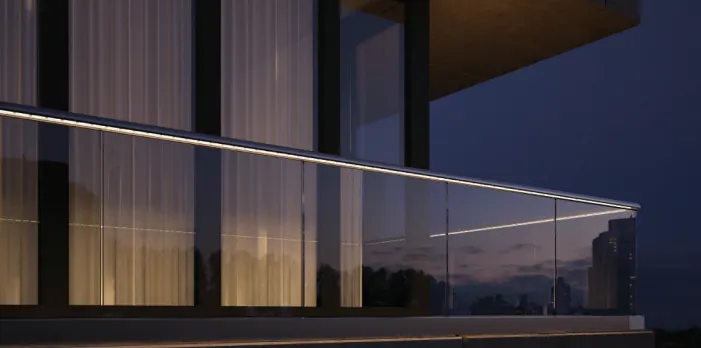
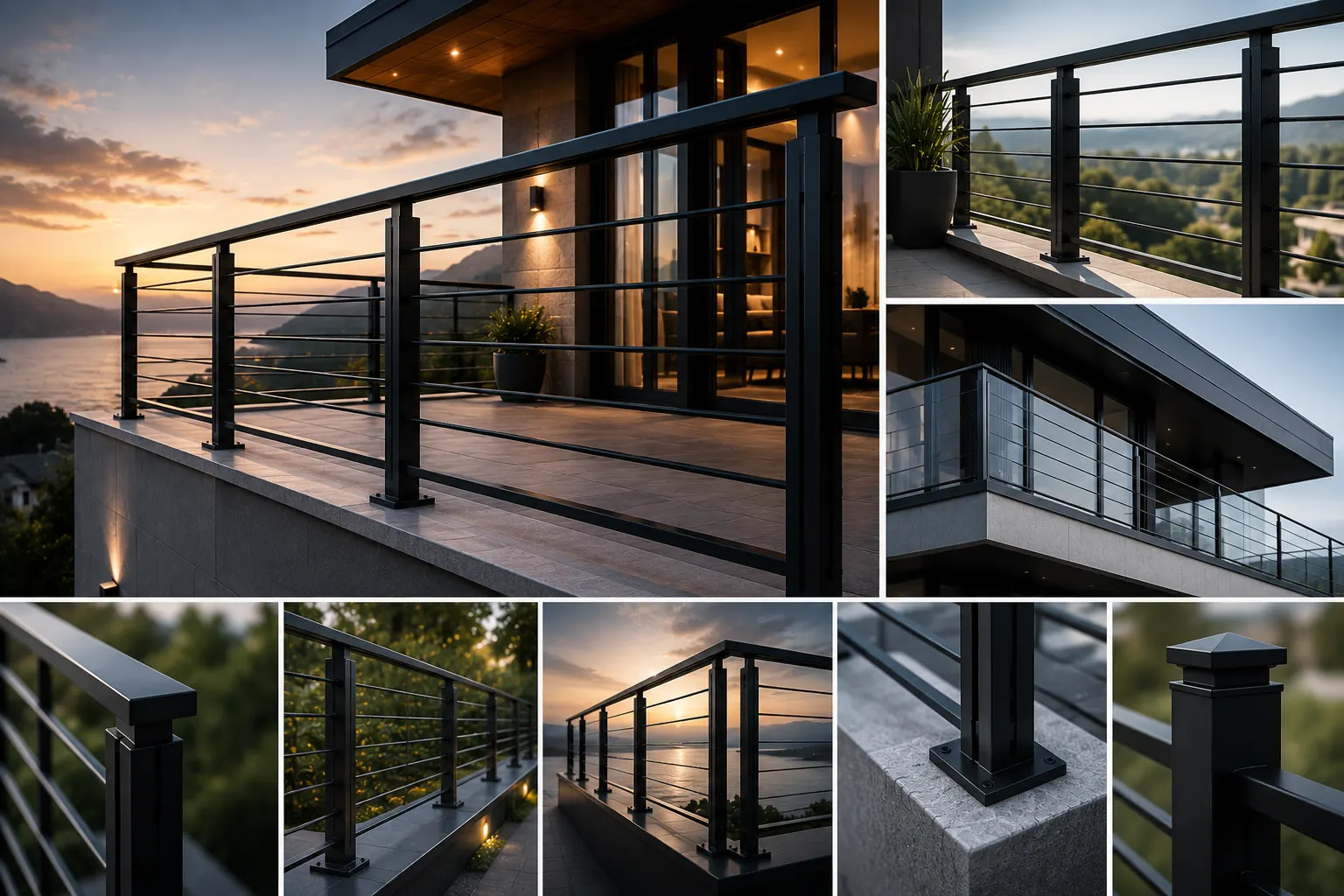
Every ALUVISTA aluminium railing begins as a raw extrusion and ends as a precisely fitted architectural element on your balcony, terrace or staircase. The journey in between — cutting, CNC machining, surface preparation, powder coating, quality control and final assembly — is what separates a commodity product from a system built to last. This guide walks through the manufacturing and installation process, including the standards that govern every step.
1. Extrusion and profile selection
ALUVISTA railings use EN AW-6063 T5 and EN AW-6061 T6 aluminium alloys — the standard for architectural extrusions. 6063 offers excellent surface quality for anodising and powder coating; 6061 is used where higher structural strength is required for tall balustrades or heavy point loads.
Profiles are extruded to our own tooling dimensions with wall thicknesses from 2.0 mm up to 4.0 mm depending on the series. Every batch arrives with a mill certificate confirming chemical composition and mechanical properties.
2. Cutting and CNC machining
Once extrusions are checked, they are cut to project-specific lengths on CNC double-mitre saws with ±0.5 mm tolerance. Mitre joints for corners are cut at 45° with automatic feeding to ensure consistency across long runs.
CNC machining centres then drill fixing holes, mill channels for glass gaskets, and create recesses for mechanical connections. Every hole position is taken directly from the shop drawing — no site improvisation required.
3. Surface finish: powder coating and anodising
All ALUVISTA railings receive a multi-stage pre-treatment: alkaline degreasing, acid etching, chromate-free conversion coating, and pure-water rinsing. This creates the micro-roughness and chemical bonding layer that makes the finish last.
Powder coating is applied in the full RAL palette with a minimum 60 µm dry-film thickness (Qualicoat class 2). Anodised finishes (Qualanod) are available on request for a metallic, scratch-resistant surface. Every batch is tested for adhesion, gloss, and salt-spray resistance before leaving the factory.
4. Assembly and quality control
Before any component leaves the workshop it is assembled in a dry-fit jig to verify geometry, hole alignment, and glass panel clearance. This catches tolerances before they become site problems.
Each railing system is packed with foam separation and edge protection, then loaded in transport sequence so the first piece needed on site is the first piece off the truck.
5. On-site installation
Installation begins with a site survey to verify slab levels, anchor positions, and glass panel dimensions. ALUVISTA installers use laser levels and adjustable base-shoe systems (AV-R50NEO, AV-N50) that can compensate for slab irregularities up to ±2° per panel.
Glass is lifted with suction cups and set into the prepared profile with EPDM gaskets and structural silicone where required. Final alignment, torque-checking of anchors, and cleaning complete the process. A typical balcony railing takes 1–2 days; a multi-storey facade can take 1–2 weeks depending on access.
Watch the manufacturing process
The video below shows the ALUVISTA aluminium railing production line — from profile cutting and machining through surface finishing to final assembly.